
NCRG Conference: Evaluating Responsible Gaming Strategies – What Regulators Need To Know
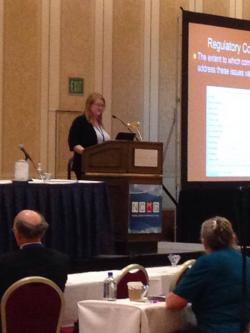
Yesterday, the14th annual NCRG Conference on Gambling and Addictionheld an informative session on using a scientific approach to evaluating responsible gambling programs thatDebi LaPlante, Ph.D., an assistant professor of psychiatry at Harvard Medical School and the director of academic affairs at the Division on Addiction, Cambridge Health Alliance, a teaching affiliate of Harvard Medical School.
Dr. LaPlante began the session by explaining that gambling disorders can cause a ripple effect—impacting the individual, his or family, acquaintances and the broader society; therefore, safeguards are often needed for some populations. One way to do this is by through regulating responsible gaming initiatives.
Some of the most common responsible gaming regulations include employee education, resources (e.g., self-exclusion programs, signage and helplines), advertising and marketing restrictions, alcohol services, credit restrictions, loss and stake limitations and mitigation efforts (e.g., treatment funding).
Dr. LaPlante noted that scientific evaluation can help guide regulator programs and provided a flow chart to show how the process works:
- Develop and utilize regulation
- Build regulation outcome monitoring system
- Assess regulation penetration among targets
- Analyze and identify best practices activities
- Summarize regulation outcomes among targets
- Conduct feedback and reporting
These steps form a circular loop. Once the feedback and reporting has been done, the process should begin again.
Dr. LaPlante added that regulations can either decrease or increase gambling-related problems, have no effect on a person’s gambling behavior or influence gambling-related problems indirectly through other factors. One example she provided was baseball’s regulation to stop selling alcohol after the seventh-inning stretch. The intention of this regulation is to limit the amount of alcohol consumed during the game, but often, spectators will purchase several alcoholic beverages before sales conclude (she referred to this as the seventh-inning binge).
Dr. LaPlante stated that regulatory evaluation might be especially important for gambling due to the limited amount of high quality information we have available, adding that what we think we know about gambling is long on anecdote and short on evidence. She provided three different examples and the most recent research on these topics to illustrate this: gambling expansion, Internet gambling and game effects.
After presenting the research, key findings and take-aways from these three examples, Dr. LaPlante posed the question: What do we know about regulations for gambling?
“Not much,” she answered. She added that often, regulations go into play with very little research to support or evaluate them. She also advised that using conventional wisdom to guide regulatory development could send us down the wrong path.
But, she noted that there are ways to know about which regulations work. First, it is important to conduct research that follows gamblers pre-and post-harm minimization effort, as well as test which behaviors and activities of problem gamblers and gambling opportunities influence their problems versus which reflect their problems. This will help inform future harm minimization strategies. She also said that there needs to be less of a reliance on self-reporting and more randomized trials, which coordination with regulators for testing.
However, she said, there are things that science can’t tell us. Sciencecantell us the costs and benefits of a given regulation, how a gambling problem develops and how regulations might intervene in that process. But, sciencecannottell us how much weight to give to individual liberty versus governmental prevention of harm.
She concluded that in an ideal world:
- We need science to tell us whether regulations and interventions do what we think they do
- Good intentions do not ensure anticipated benefits or prevented unanticipated harms.
- Evidence-based regulations will preclude the development of policy based on individual whim and advocate lobbying
- A science of regulations will ensure that legislation provides targeted influence in the intended direction
While gambling creates opportunities to improve and complicate day-to-day life, the challenges that we face are: (1) to be aware of the changes gambling might create, (2) to navigate the changing opportunities safely and (3) to get ahead of naturally-occurring adaptation, and facilitate the dissolution of novelty effects among those most at-risk.
Did you attend this session? What else did you take away from Dr. LaPlante’s presentation?
NCRG staffConference on Gambling and AddictionDr. Debi LaPlanteNCRG ConferenceRegulatorsresponsible gaming